Zero-Turn vs Lawn Tractor: Which Fits Your Yard?
They cost about the same and both cut grass — but they suit very different properties. Here is how to choose without regret.
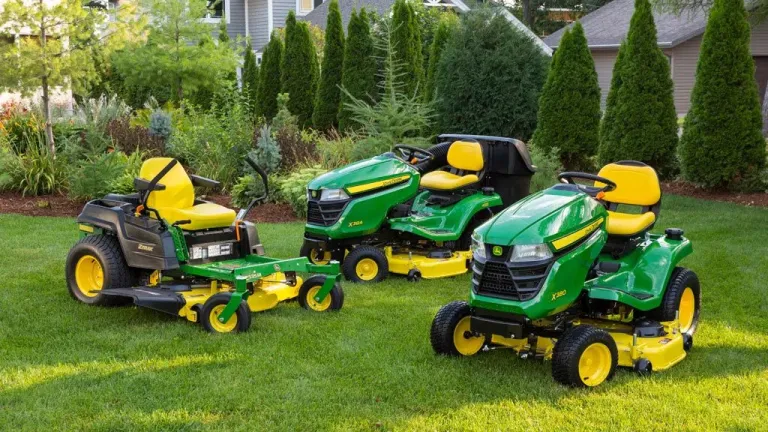
Walk into any dealership and the two machines are sitting side by side at roughly the same money. Both cut grass. Both have a seat, an engine and a deck. And the salesman will cheerfully sell you either one.
But they are built around completely different ideas, and the wrong choice will quietly annoy you every weekend for the next ten years. The good news: the decision is barely about the machines at all. It is about your yard.
The short answer
- Flat, open lawn with trees, beds and fences to work around, and mowing is the whole job? Get a zero-turn. You will cut your mowing time by roughly a third and trim far less afterwards.
- Slopes, towing, attachments, or you want to move snow in winter? Get a lawn tractor. Not a compromise — the right tool.
- Slopes steeper than about 15 degrees? Neither. We mean that literally, and the slope section below explains why.
If that settles it, you can stop reading. If not, here is the reasoning.
They steer in totally different ways — everything follows from that
A lawn tractor is basically a car. You turn a wheel, the front wheels point, the machine follows. Power goes to the back. Familiar, predictable, boring in the best possible sense.
A zero-turn has no steering wheel. It has two lap bars, and each one drives one rear wheel independently. Push both forward and you go straight. Push one forward while pulling the other back and the machine spins inside its own footprint — hence the name. The front wheels are unpowered casters that just trail along, like the wheels on an office chair.
That single mechanical difference is the source of every advantage and every weakness that follows. Keep it in your head and the rest of this guide is obvious.
Where the zero-turn wins
It is genuinely, substantially faster
Zero-turns typically run 6 to 8 mph. Lawn tractors cruise nearer 4 to 5. On top of the raw speed you stop wasting time on a three-point turn at the end of every single pass. The commonly cited saving is 30 to 40 percent on comparable ground, and more than that if your lawn is cluttered.
Put it in real terms. If mowing currently eats two and a half hours of your Saturday, you are buying back the better part of an hour — every week, for years. That is the actual product.
It cuts *around* obstacles, not near them
This is the underrated one. Go around a tree on a lawn tractor and you leave a ring of uncut grass that you have to come back and trim by hand. A zero-turn pivots and takes the grass right up to the trunk. Same story with flower beds, fence lines, mailbox posts and that awkward corner by the shed.
So in a cluttered yard the advantage compounds: the zero-turn is faster per pass and it deletes the trimming session that used to follow.
Where the lawn tractor wins
Towing and attachments
A tractor is a small utility vehicle that happens to mow. It will pull a cart, a spreader, an aerator, a dethatcher, a roller. Many take a snow blade or a blower in winter, which means the machine earns its keep twelve months a year instead of six.
Zero-turns can tow, but they are worse at it: less weight over the drive wheels, lower hitch ratings, and a caster front end that wanders under load. If hauling mulch and topsoil is a normal part of your year, this matters far more than mowing speed does.
It is much easier to learn
Lap bars are counterintuitive at first. New owners routinely scuff and tear turf in their first few sessions, and reversing is a genuine skill. A tractor you can drive competently in ten minutes, because you already know how to drive a car.
It costs less to get in the door
Entry-level lawn tractors start meaningfully below entry-level zero-turns. The two ranges overlap heavily once you are past roughly $3,500, but if the budget is genuinely tight, the tractor buys you more deck for the money.
The slope question is the one that actually matters
Read this section even if you skim everything else.
On a hill, a zero-turn is the worst riding machine you can be on. Not "slightly less good" — worst. Here is the mechanism, and it is worth understanding rather than just taking on faith.
A zero-turn steers by driving its rear wheels at different speeds. On a slope, when a rear wheel loses grip, you do not merely lose traction — you lose steering. At that moment you are a passenger on something sliding sideways. If a sliding tire then catches a dip or a root, the slide becomes a rollover.
A lawn tractor's front wheels keep pointing wherever you aimed them, no matter what the rear wheels are doing. That is the entire difference, and on a hill it is everything.
Independent testing has found precisely this: zero-turns that coped fine going straight up and down a grade lost most of their steering the moment they were asked to make a hard turn on a 10-to-15-degree slope. Worth knowing too: most zero-turns have no foot brake. You stop by working the same two levers you steer with — a lot to ask of yourself in a moment of panic.
Some numbers to anchor it:
- 15 degrees is the manufacturers' hard ceiling. Toro's guidance is blunt: never operate a zero-turn on a slope steeper than that. Most other makers say the same in their manuals.
- OSHA's framework for professional grounds crews runs: 0 to 15 degrees, a riding mower or tractor mower is acceptable; 15 to 22 degrees, a tractor mower only; above 22 degrees, nobody rides anything — string trimmers, walk-behinds or purpose-built slope machines.
- To picture 15 degrees: roughly a 5-foot rise over a 20-foot run.
If you have any real slope, these rules are not optional:
- Once slopes reach 10 to 15 degrees, choose a front-steering tractor over a zero-turn.
- On a rider, mow up and down the slope, never across it. (Walk-behind mowers are the opposite — those you mow across.)
- Always turn uphill, never downhill.
- Dry grass only. Wet grass is exactly where the traction disappears.
- Use the rollover bar (ROPS) with the seatbelt fastened. Together they are close to fully protective in a rollover. The bar without the belt is dramatically less so — an unbelted operator can be thrown out from under the very structure meant to protect them.
If a slope is genuinely too steep to mow safely, landscape it. Beds, groundcover, wildflowers, mulch — anything. It is only grass. It is not worth a rollover, and no amount of horsepower makes a zero-turn safe on a hill it was never designed for.
The one spec worth spending money on
Whichever type you buy, look hard at the transmission. It is the part that quietly decides whether your machine lasts five years or fifteen.
The Hydro-Gear EZT fitted to most entry-level zero-turns is a sealed unit — no serviceable fluid, no rebuild. Owners commonly report them giving out somewhere around the 250-hour mark. Mowing one flat acre a week, that is many seasons away and you will probably never meet it. Grinding through three acres of rough ground, it is a countdown.
Step up to a serviceable transaxle — Hydro-Gear ZT-2800, ZT-3400 and above — and you own a machine you can maintain instead of replace. If you are deciding where the last few hundred dollars of your budget should go, put it here rather than into extra horsepower you will never use.
Do not buy more deck than your yard can use
A rough sizing guide:
- Under half an acre — you probably do not need a rider at all.
- Half to one acre — a 42-inch deck.
- One to three acres — 46 to 54 inches.
- Three acres and up — 54 to 60 inches.
But obstacles beat the chart. A cluttered one-acre lot with mature trees is better served by a smaller, nimbler deck than the acreage alone suggests. A wide deck you cannot fit between the shed and the fence is a wide deck you will resent every week.
Five questions that settle it
- Is any part of my lawn steeper than about 10 degrees? Yes → tractor. Steeper than 15 → neither; rethink the slope entirely.
- Do I need to tow, haul or plow? Yes → tractor.
- How many trees, beds and fences do I mow around? Lots → zero-turn.
- What is an hour of my weekend actually worth to me? A lot → zero-turn.
- Can my budget reach a transmission I will not have to replace? If not, a tractor gets you more machine for the money today.
The verdict
For a flat, open, obstacle-heavy lawn where mowing is the entire job, the zero-turn is simply the better tool, and it is not close. You will finish sooner, trim less, and — this is not a small thing — enjoy it more.
For hills, hauling and year-round work, the lawn tractor is not the consolation prize. It is the correct machine, and buying a zero-turn instead is a mistake you will make every single week.
And if you have real slopes, the answer is not about preference at all. It is about not rolling a 700-pound machine onto yourself.
If a zero-turn is the right call for your yard, our mower finder will match you to one in four questions, or you can browse every model we have reviewed.